Where to Live in Kanto: A Practical Guide to Tokyo Commuting and Daily Life
Choosing a home in the Tokyo–Kanto region is a transport decision as much as a housing decision. The lowest rent can become expensive in time, fatigue, transfers, taxis, and missed family or study time. Compare the full weekday routine before choosing a city or station.
Start with the exact destination
Use the building or campus entrance—not only “Shinjuku,” “Shibuya,” or “Tokyo”—as the destination. Large business districts have several stations and exits. Ten extra minutes underground at each end can change whether a route feels sustainable.
Measure door to door
Break the trip into six parts:
- Home to station
- Station entrance to platform
- Waiting time
- Train ride and transfers
- Arrival platform to exit
- Exit to workplace or school
Test the route at your real departure time on a weekday. Midday route results may not represent peak-hour stopping patterns, crowding, queues or delays.
Direct train or cheaper rent?
A direct route often reduces daily uncertainty. A transfer route may offer lower rent or a larger home, but assess the transfer station: platform distance, stairs, congestion, missed connections and reduced service late at night. Compare at least one direct-route area and one lower-cost transfer area.
Compare real rental examples across Kanto
These are sample areas for comparison, not properties in a specific neighborhood.
RENTAL LISTING SNAPSHOT
Real rental examples around Kawaguchi
These listings were found on SUUMO and checked on October 20, 2026. Availability changes quickly. For foreign-resident acceptance, guarantor requirements, documents, initial costs or detailed conditions, ask Japan Live before applying.
築5年
埼玉高速鉄道/川口元郷駅 歩10分
埼玉県川口市朝日1Get move-in tips →
Source listing on SUUMO ↗
Browse all current Kawaguchi rentals on SUUMO ↗
Checked October 20, 2026. Listings are examples, not recommendations. Japan Live is not the listing agent and does not guarantee availability or approval.
RENTAL LISTING SNAPSHOT
Real rental examples around Wako
These listings were found on SUUMO and checked on October 20, 2026. Availability changes quickly. For foreign-resident acceptance, guarantor requirements, documents, initial costs or detailed conditions, ask Japan Live before applying.
築2年
東武東上線/成増駅 歩14分
埼玉県和光市白子3Get move-in tips →
Source listing on SUUMO ↗
Browse all current Wako rentals on SUUMO ↗
Checked October 20, 2026. Listings are examples, not recommendations. Japan Live is not the listing agent and does not guarantee availability or approval.
RENTAL LISTING SNAPSHOT
Real rental examples around Matsudo
These listings were found on SUUMO and checked on October 20, 2026. Availability changes quickly. For foreign-resident acceptance, guarantor requirements, documents, initial costs or detailed conditions, ask Japan Live before applying.
新築
東武野田線/六実駅 歩11分
千葉県松戸市六高台2Get move-in tips →
Source listing on SUUMO ↗
Browse all current Matsudo rentals on SUUMO ↗
Checked October 20, 2026. Listings are examples, not recommendations. Japan Live is not the listing agent and does not guarantee availability or approval.
Check both directions
The return journey can be different from the morning. Confirm evening frequency, the last practical train, station exits that remain open, and the cost of a taxi from a major station if service stops. If your job has irregular hours, late-night resilience matters more than the fastest daytime journey.
Walking distance is part of the commute
- Is the route flat or hilly?
- Are there long crossings or railway gates?
- Is it comfortable in rain, summer heat and winter darkness?
- Can you use a bicycle, and is legal parking available?
- Is the route well-lit after dark?
- Are flood-prone streets or narrow roads involved?
A “10-minute walk” deserves an actual route check. Listing conventions and real walking conditions are not the same thing.
Kanto rent snapshot for single-person homes
For a first comparison, use the same housing type across every area. The figures below are October 2026 planning references for studios, 1K and 1DK homes. They are asking-rent indicators—not guaranteed prices—and the exact result changes with room size, building age, station distance and property condition.
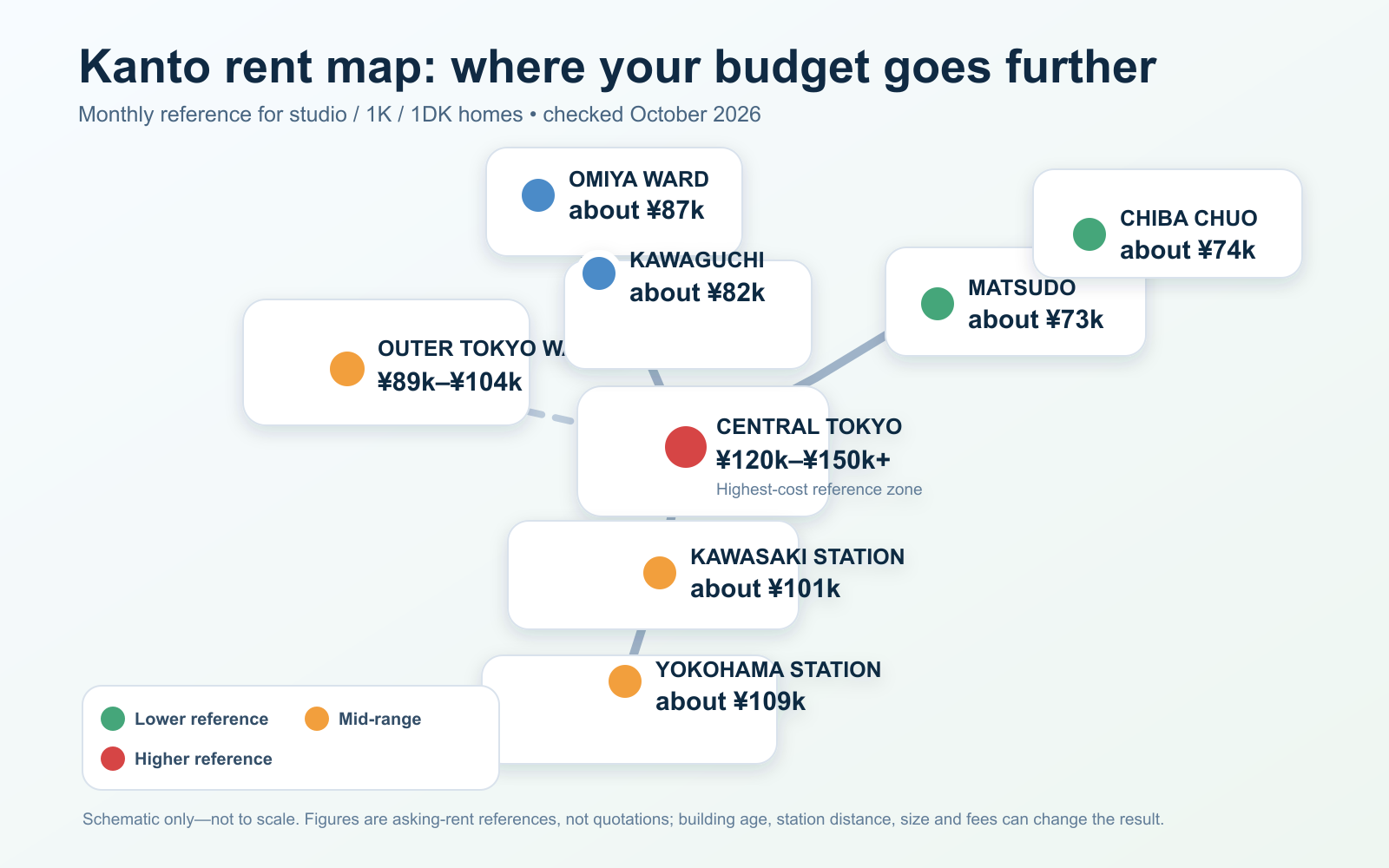
| Area reference | Monthly rent reference | How to read it |
|---|---|---|
| Central Tokyo wards | ¥120,000–¥150,000+ | Shorter central commute, but the highest budget pressure. |
| Outer north/east Tokyo wards | ¥89,000–¥104,000 | Often a middle ground between Tokyo access and rent. |
| Kawaguchi | about ¥82,000 | Useful for routes through Akabane and the Keihin-Tohoku Line. |
| Omiya Ward | about ¥87,000 | Major rail hub; compare the total journey from each neighborhood. |
| Matsudo | about ¥73,000 | Lower reference with access toward Ueno and northeast Tokyo. |
| Chiba Chuo Ward | about ¥74,000 | Lower rent reference, but a longer trip to many Tokyo workplaces. |
| Kawasaki Station | about ¥101,000 | Station-based figure; strong access to Shinagawa and Yokohama. |
| Yokohama Station | about ¥109,000 | Station-based figure; convenient, but higher than many suburban areas. |
Important: city/ward figures and station figures cover different search areas, so use them to shortlist locations rather than rank them as exact equivalents. LIFULL HOME’S states that its reference model is based on average rent for properties within a 10-minute walk of a station and excludes management fees and parking. Always compare the current listing’s rent plus management/common-service fees.
Market direction also matters. At Home’s August 2026 report found year-on-year increases across all apartment-size bands in Tokyo’s 23 wards, suburban Tokyo, Kanagawa, Saitama and Chiba. Build some headroom into your budget and recheck live listings near your application date.
Sources: LIFULL HOME’S rent reference pages (checked October 2026) and At Home: August 2026 asking-rent trends.
Budget beyond rent
Compare total monthly housing cost, commuting cost not covered by an employer or school, bicycle or parking fees, and the cost of late-night alternatives. Also value your time: an additional hour every weekday is a major lifestyle cost even when it does not appear on an invoice.
Daily life around the station
A practical neighborhood supports the hours you actually keep. Check:
- Supermarket and pharmacy hours after your return time
- Clinic, dentist and hospital access
- City or ward office and multilingual consultation
- Bank, ATM, post office and parcel services
- Childcare, school, parks or community facilities
- Restaurants and affordable prepared food
- Rubbish collection rules and disposal location
Choose the correct side of a station
The same station can have very different neighborhoods on each side. A railway, river, highway or large shopping complex may make crossing inconvenient. Compare the exact property route, not only the station name.
Disaster and disruption planning
Review municipal hazard maps for flood, landslide, tsunami and other local risks that apply to the address. Identify an evacuation site and an alternative way home. In a major disruption, the ability to walk part of the route or reach another line can matter.
A five-score comparison
Score each candidate area from 1 to 5 for:
- Total housing cost
- Peak-hour door-to-door commute
- Transfer and delay resilience
- Daily-life convenience
- Personal priorities such as quiet, family support or international services
Write one reason beside every score. This makes tradeoffs visible and prevents an attractive listing from overriding the original requirements.
Test before committing when possible
If you are new to Kanto, temporary housing can let you travel the route during peak hours, visit supermarkets after work, and inspect several neighborhoods. The short-term cost may be worthwhile when the long-term lease is difficult to cancel or expensive to enter.
Related guides
- Complete guide to renting in Japan before arrival
- Remote apartment viewing before arriving in Japan
- Japan apartment initial costs explained
Ask by email
Send your work or school address, expected schedule, housing budget, household size and preferred commute limit. Japan Live can help you organize areas to compare.
Start an email-based area consultation →
Travel times, fares, timetables and service patterns change. Verify current routes with transport operators and test the trip at the time you expect to travel.
Where should you live?
Compare neighborhoods using your destination, realistic rent ceiling, commute limit, household and lifestyle priorities. Results are ranked with an explainable score instead of a fixed shortlist.
Travel times and rent bands are planning estimates, not live listings. Always verify the exact route, property and move-in conditions.
We can help you understand what to check before moving: rental documents, move-in costs, utilities, local services and everyday living rules. Tell us what you need help with.
Get practical Japan living tips →